Understanding NCR (Non-Cognizable Report): Legal Meaning, Procedure & Implications in India
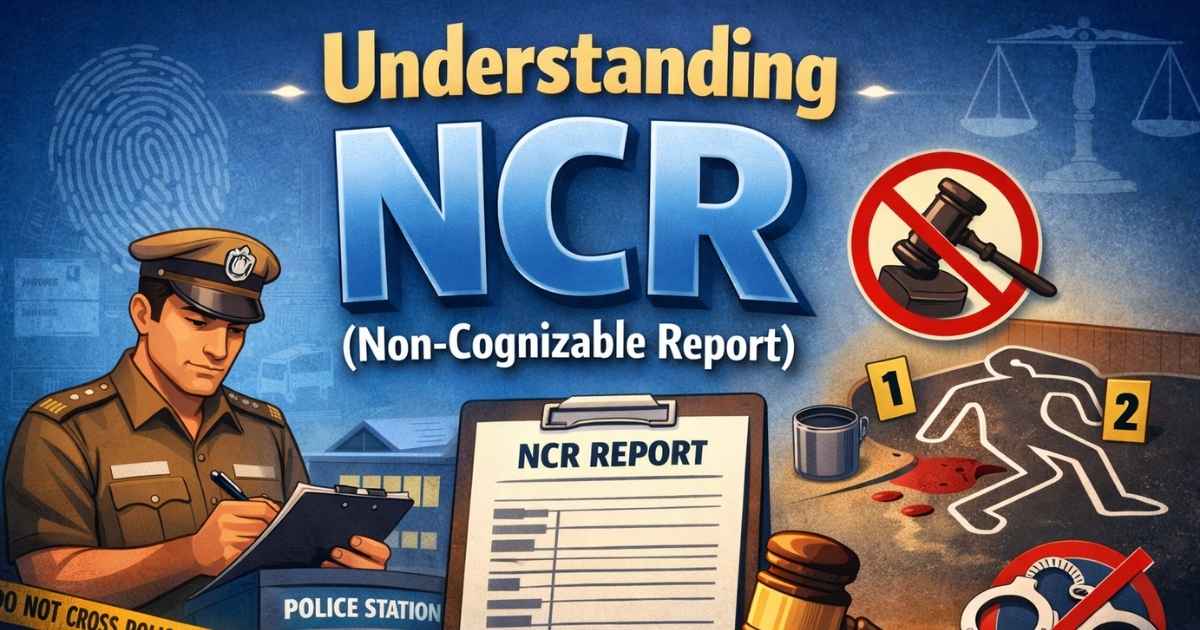
When people approach a police station with a complaint, they often expect the police to register an FIR immediately. However, not every complaint qualifies for a First Information Report. In many situations involving minor disputes or less serious allegations, the police record the matter as a Non-Cognizable Report (NCR) instead. Understanding NCR (Non-Cognizable Report): Legal Meaning, Procedure & Implications in India helps citizens recognize how the law treats such cases and why police sometimes refuse to register an FIR.
In simple terms, an NCR is a police record of a complaint relating to a non-cognizable offence, meaning the police cannot arrest the accused or begin a formal investigation without permission from a Magistrate. These offences usually involve minor criminal offences in India such as verbal abuse, public nuisance, or minor altercations. Although an NCR may appear less serious than an FIR, it still serves as an official entry in police record documentation and can become relevant if the dispute escalates.
Related post: IPS Promotion Chart With Years: A Complete Career Progression Guide in the Indian Police Service
Legal Basis of NCRs in Indian Law
The legal framework governing NCRs comes from modern criminal procedure statutes in India. The Bharatiya Nagarik Suraksha Sanhita 2023 outlines the process of criminal complaint registration and explains how police should handle non-cognizable cases. Alongside this, the Bharatiya Nyaya Sanhita 2023 provides the list of offences and their classifications, including the BNSS non cognizable offences list that guides police officers in determining whether a complaint qualifies for an NCR or an FIR.
Under the broader criminal procedure in India, the police station complaint process requires officers to assess the nature of the offence first. If the complaint relates to minor criminal offence law categories, they record the matter as an NCR rather than an FIR. This distinction ensures that police investigation powers are not used unnecessarily in minor disputes while still preserving a formal record of the complaint.
Under BNSS (Bharatiya Nagarik Suraksha Sanhita), 2023:
The BNSS clearly defines how non-cognizable cases should be handled. Section 173 BNSS states that a police officer cannot investigate a non-cognizable case without the order of a Magistrate. This rule acts as a safeguard against misuse of police authority and reinforces the role of judicial oversight in the criminal justice system India.
Another relevant provision is Section 190 BNSS, which allows a Magistrate to take cognizance of an offence upon receiving a complaint. If the complainant believes further action is necessary, they can approach the Magistrate for a magistrate order for investigation. This balance between police authority and judicial control ensures fairness within the Indian criminal law procedure.
Examples of Non-Cognizable Offences
Non-cognizable offences generally involve acts that cause inconvenience, insult, or minor harm but do not pose a serious threat to life or property. These cases often arise from neighborhood disputes, workplace arguments, or personal disagreements. Many citizens file a police complaint for minor offences when such conflicts occur.
Some common examples of non-cognizable offences include:
| Offence | Typical Punishment | Nature |
| Public nuisance | Fine | Non-cognizable |
| Defamation complaint police India | Up to 2 years | Non-cognizable |
| Criminal intimidation non cognizable | Up to 2 years | Non-cognizable |
| Simple hurt complaint police | Fine or short imprisonment | Non-cognizable |
| Minor scuffle without injury | Fine | Non-cognizable |
For example, imagine two neighbors arguing loudly over a parking dispute. If one person uses insulting language but causes no physical injury, the police may record the complaint as an NCR instead of registering an FIR.
Procedure of Filing an NCR
Filing an NCR is relatively straightforward. The process begins when the complainant approaches the Station House Officer at the relevant police station. The officer listens to the complaint and determines whether the incident qualifies as a cognizable or non-cognizable offence based on the schedule of offences.
If the complaint falls under the category of non-cognizable offences, the police record it in the station diary as an NCR. The complainant receives a copy of the report free of cost. Although the police cannot begin an investigation immediately, the entry ensures that the complaint becomes part of official police records and can be used later in legal proceedings if needed.
Step-by-Step Guide:
The non cognizable case procedure typically follows these steps:
- The complainant visits the nearest police station.
- The officer evaluates the nature of the alleged offence.
- If the act is non-cognizable, an NCR is recorded.
- The complainant receives a copy of the report.
- If further action is required, the matter may be placed before a Magistrate for investigation approval.
This process answers a common question many citizens ask: how to file NCR in police station when the police say the matter does not qualify for an FIR.
Key Differences Between FIR and NCR
Understanding the NCR vs FIR difference helps clarify how Indian criminal law treats different categories of offences. While both involve recording complaints with the police, they differ significantly in legal consequences and investigative authority.
The First Information Report (FIR) applies to serious offences such as theft, murder, or assault. In such cases, police can immediately begin an investigation and even make a warrant based arrest if required. NCRs, on the other hand, relate to minor criminal offences where the police cannot take immediate investigative action.
| Feature | FIR | NCR |
| Type of offence | Cognizable | Non-cognizable |
| Arrest power | Police may arrest without warrant | Requires court approval |
| Investigation | Immediate | Only with Magistrate permission |
| Legal impact | Leads to criminal trial initiation | May remain a record unless escalated |
What Happens After NCR is Filed?
Many people assume that once an NCR is filed nothing happens afterward. In reality, the report still plays an important role in the criminal justice system India. Police maintain the record and may intervene informally to prevent the dispute from escalating.
The legal procedure after NCR often involves preventive action by the police. Officers might warn the accused, mediate between parties, or advise them to resolve the matter peacefully. In repeated disputes, multiple NCRs can signal a pattern of problematic behavior and may influence future legal decisions.
Aftermath of an NCR:
After an NCR is recorded, several outcomes are possible:
- Police may attempt mediation between the parties.
- The complainant may approach a Magistrate for further action.
- If the offence escalates into a serious crime, a fresh FIR can be registered.
- Courts may consider past NCR entries during anticipatory bail consideration.
Therefore, an NCR should not be dismissed as meaningless. It remains a documented complaint that could influence magistrate court proceedings later.
Role of Magistrate in Non-Cognizable Cases
Since police powers in non cognizable cases are limited, the Judicial Magistrate authority becomes crucial. The Magistrate acts as a gatekeeper who decides whether further investigation should take place.
If the complainant believes the matter requires deeper scrutiny, they can request the court to direct the police to investigate. Upon reviewing the facts, the Magistrate may issue instructions to the police under applicable provisions of law. This ensures that even minor disputes receive judicial attention if circumstances demand it.
Rights of the Complainant in NCR
Many citizens assume that they lose their rights once the police classify their complaint as non-cognizable. That is not true. The legal rights of complainant remain protected even in such cases.
A complainant has the right to insist that the police record the complaint as an NCR if it relates to a non-cognizable offence. They are also entitled to receive a free copy of the report. If the police refuse to take further action, the complainant may approach a Magistrate seeking legal remedy for minor disputes through private complaint proceedings.
Can an NCR Be Converted into an FIR?
Yes, an NCR can eventually lead to an FIR if circumstances change. This usually happens when new evidence emerges or when the accused commits a more serious offence related to the same dispute.
For example, suppose someone initially files an NCR for verbal abuse. If the accused later physically assaults the complainant, the police may register a full FIR because the incident now falls under a cognizable offence. Lawyers often monitor such cases carefully because converting NCR to FIR can significantly alter the legal strategy.
Can You Check NCR Status Online?
Many state police departments now offer digital services that make it easier for citizens to track complaints. In several states, online portals allow users to check complaint numbers and police records.
However, NCR records are generally less accessible online than FIR records. Authorities often limit public access because these cases involve sensitive personal disputes. Even so, complainants can still obtain updates directly from the police station or through official complaint tracking systems.
Practical Insights for Advocates and Litigants
For lawyers and litigants, NCR entries often serve as early indicators of disputes that may later turn into serious litigation. Experienced advocates frequently examine NCR records when preparing defense strategies or evaluating potential criminal trial initiation.
From a legal perspective, multiple NCR entries against the same person may influence anticipatory bail consideration or affect credibility in court. They can also strengthen arguments regarding repeated harassment or ongoing conflict between parties.
Landmark Case Laws
Indian courts have delivered several judgments clarifying the distinction between cognizable and non-cognizable offences.
1. Lalita Kumari v. Government of Uttar Pradesh (2013) 14 SCC 350
In this landmark ruling, the Supreme Court held that police must register an FIR when information discloses a cognizable offence. However, when the complaint relates to a non-cognizable offence, the police may record it as an NCR instead.
2. State of Haryana v. Bhajan Lal (1992) Supp (1) SCC 335
This judgment established guidelines for the exercise of police investigation powers. It also emphasized that courts should prevent abuse of criminal law in cases involving minor disputes or malicious complaints.
3. Subramanian Swamy v. Union of India (2016) 7 SCC 221
The Supreme Court upheld the constitutionality of criminal defamation and confirmed that defamation remains a non-cognizable offence. As a result, such complaints typically begin with an NCR or private complaint before the Magistrate.
Common Misconceptions About NCR
Many myths surround the concept of NCR. People often misunderstand its legal importance.
| Myth | Reality |
| NCR has no legal value | It is an official police record |
| Police ignore NCR complaints | Police may mediate disputes |
| NCR automatically becomes FIR | Only if new facts emerge |
| NCR means no legal remedy | Complainants can approach court |
Understanding these misconceptions helps citizens appreciate how the criminal justice system balances minor complaints with judicial oversight.
Conclusion
The concept explained in Understanding NCR (Non-Cognizable Report): Legal Meaning, Procedure & Implications in India highlights an important feature of the Indian criminal law system. Not every dispute requires immediate police investigation or arrest. NCRs allow citizens to record complaints about minor offences while ensuring that police authority is not misused.
At the same time, NCRs preserve a documented history of disputes. If a conflict escalates or new evidence emerges, the case may move forward through court directions or FIR registration. For ordinary citizens, knowing how NCR works can make interactions with the police clearer and less frustrating.

Arjun Sethi is a legal researcher and columnist specializing in constitutional and comparative law. A graduate of NALSAR University, he has published in leading law journals and advised policy think tanks. His work bridges theory and practice, offering readers precise, well-researched insights grounded in academic rigor and ethical clarity.