Section 251 CrPC: The Gateway to Fair Trial in Summons Matters A Comprehensive Analysis
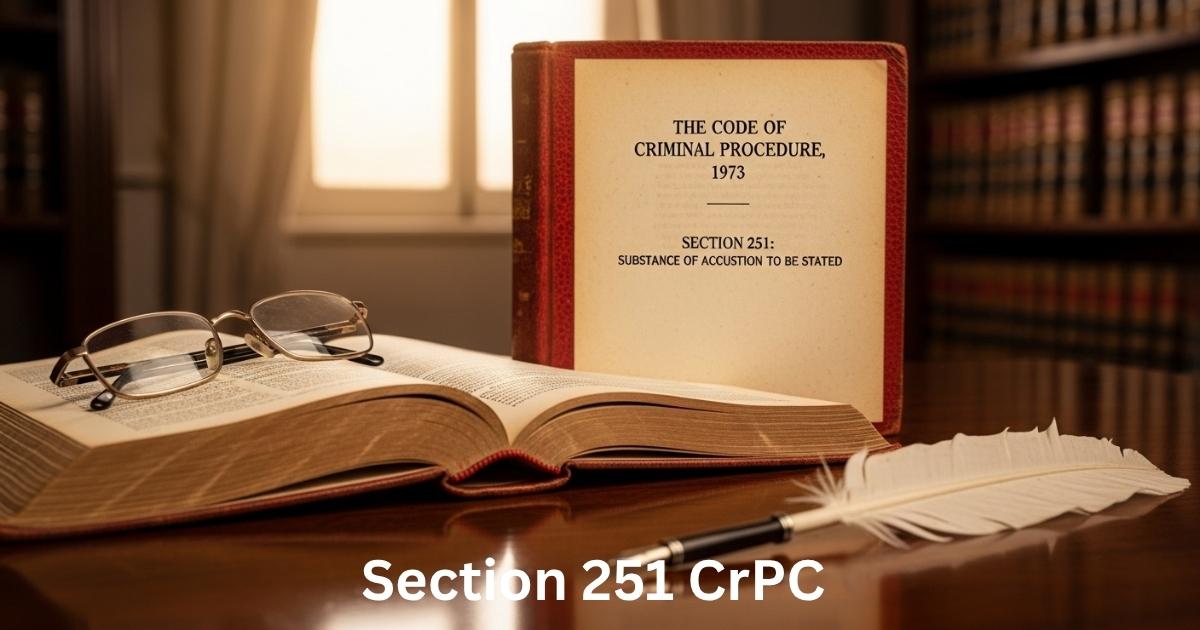
Criminal cases don’t begin with evidence. They begin with procedure. And in summons trials across India, Section 251 CrPC is where that procedure takes its first real step. This provision sits inside Chapter XX of the Code of Criminal Procedure, 1973. It governs the moment an accused person appears before a Magistrate. The court must state the substance of the accusation clearly. Then the accused gets a chance to plead or defend themselves.
Simple as that sounds, Section 251 carries enormous legal weight. It protects the accused from facing trial without knowing the allegations. It gives Magistrates a gatekeeping role against frivolous prosecutions. It balances fairness with procedural speed. Whether you’re a litigator, a law student, or someone who just received a court summons understanding this provision matters more than you think.
Related Post: Who Are Agnates and Cognates? Understanding Family Relations in Hindu Succession Law
I. Statutory Text and Scope
Chapter XX of the Code of Criminal Procedure, 1973 deals specifically with the trial of summons cases by Magistrates. Section 251 sits right at its core not as a technical formality but as a substantive protection for every accused who appears before a Magistrate in a summons matter.
The provision is concise but loaded. It requires the Magistrate to state the particulars of the offence, invite a plea or defence, and crucially, it exempts the court from framing a formal charge. That exemption isn’t laziness built into the law it’s deliberate procedural economy designed for less serious offences.
A. Bare-Text and Position in CrPC
The statute reads: “When in a summons-case the accused appears or is brought before the Magistrate, the particulars of the offence of which he is accused shall be stated to him, and he shall be asked whether he pleads guilty or has any defence to make, but it shall not be necessary to frame a formal charge.”
Two phrases carry the real weight here. “Summons-case” limits the provision’s reach it doesn’t apply to warrant trials. “Particulars of the offence” means the essential elements: the act or omission alleged, the time, the place, and the relevant legal provision. Not every procedural detail. Just enough for the accused to understand and respond.
B. Distinction from Warrant Trials and Formal Charge Framing
In a warrant trial, charge framing under Sections 239 and 240 CrPC is a mandatory, elaborate step. The court examines documents, hears both sides and then formally frames charges with specificity. In a summons trial, that full machinery doesn’t run. Section 251 replaces it with a lighter but still meaningful process.
Don’t mistake “lighter” for “toothless,” though. The substance of accusation still must be communicated clearly. The accused still gets a chance to plead or defend. The difference lies in form, not in the fairness of the outcome.
| Feature | Warrant Trial | Summons Trial |
| Formal charge framing | Mandatory | Not required |
| Discharge provision | Explicit in CrPC | Judicially recognized |
| Procedural pace | Slower, more elaborate | Faster, simplified |
| Plea recording | After charge framing | After stating substance |
II. Objectives and Rationale
Every procedural provision serves a purpose. Section 251 serves several simultaneously and understanding them helps you appreciate why courts treat it seriously even when its text seems brief.
The most fundamental objective is notice. You can’t defend yourself against accusations you don’t know exist. The audi alteram partem doctrine hear the other side demands that every accused person understands the case against them before trial proceeds. Section 251 operationalizes this principle specifically for summons cases. Beyond notice, the provision also acts as an early judicial filter. Before stating the substance, the Magistrate reviews the complaint and accompanying documents. This implicit screening catches frivolous, malicious, or legally deficient prosecutions before they cause damage.
III. Judicial Interpretations and Landmark Precedents
Courts haven’t left Section 251 to float without definition. Decades of judicial interpretation have sharpened its contours and filled in gaps the bare text left open. Understanding these decisions is essential for any practitioner navigating this stage.
The Supreme Court and various High Courts have consistently held that Section 251 isn’t a mechanical checkbox. It carries substantive obligations for the Magistrate, for the prosecution and for the defense. Missing those obligations can vitiate proceedings entirely.
A. Duty of Magistrate to “Satisfy Oneself” Before Proceeding
The Magistrate doesn’t simply read out accusations. Before invoking Section 251, courts have held that the Magistrate must examine whether the allegations taken at face value actually constitute a cognizable offence. Think of it as a prima facie filter built into the process.
If the material on record doesn’t support the alleged offence even hypothetically, the Magistrate is bound to stop proceedings. Proceeding mechanically in such cases doesn’t serve justice it enables harassment.
B. No Formal Framing of Charge Required
Multiple High Courts have confirmed what the statute already states: there’s no requirement to frame a formal charge in a summons trial. But “no formal charge” doesn’t mean “no clarity.” The substance must be communicated the essential facts, the legal provision, the nature of the accusation.
Courts have specifically held that vague or perfunctory statements at this stage don’t satisfy the requirement. The accused must genuinely understand what they’re being asked to answer.
C. Discharge Under Section 251 Contentious but Recognized in Certain Contexts
Here’s one of the most debated areas in summons trial procedure. CrPC doesn’t explicitly provide for discharge in summons cases the way it does in warrant trials. Yet the Supreme Court in Municipal Council, Raipur (AIR 1970 SC 1923) recognized that discharge is permissible in complaint-based summons cases where allegations are patently baseless.
Courts don’t treat this lightly, though. Discharge must be the exception. It demands recorded reasons. And once the accused pleads not guilty and trial begins, courts become far more reluctant to revisit the question. The power exists but it isn’t a routine exit route.
D. Personal Appearance of Accused Not Always Mandatory
The Andhra Pradesh High Court and others have ruled that if the accused’s personal attendance has been dispensed with under Section 205 CrPC, a duly authorized pleader can appear on their behalf at the Section 251 stage.
This is practically significant. In cases involving corporate accused, elderly or infirm clients, or outstation matters, rigid insistence on personal presence serves no real purpose. The accused’s rights aren’t diminished by their counsel’s appearance so long as the representation is genuine and authorized.
E. Opportunity to Address Arguments at 251 Stage
Several courts have recognized that the accused should have an opportunity to address the court before a Section 251 notice is formally framed. This isn’t just courtesy it’s a meaningful check on whether proceedings ought to continue at all.
The defense can argue that the complaint discloses no offence, that the allegations are inherently contradictory, or that essential ingredients of the alleged offence are missing. Courts that allow this at the 251 stage save everyone significant time and resources.
IV. Procedural Safeguards and Crux of Stage
The Section 251 stage follows a clear sequence. Each step carries obligations and missing any one of them can give rise to legitimate procedural challenges. Here’s how it actually unfolds:
Step 1 Documents must reach the accused first. The police report, FIR, witness statements and other documents must be furnished before the court proceeds. Section 207 CrPC mandates this. Without it, the Section 251 stage is premature.
Step 2 Magistrate reviews the record. The court examines whether the material discloses a prima facie case. This is the gatekeeping moment.
Step 3 Substance of accusation gets stated. Essential facts, the alleged act or omission, relevant legal provision clearly, in language the accused understands.
Step 4 Plea gets recorded. Guilty or not guilty. The response becomes part of the permanent record.
Step 5 Arguments may be heard (best practice). Many courts now allow the defense to address whether proceedings should continue at all before the 251 notice issues.
Step 6 251 notice issues. Only if the court is satisfied a prima facie case exists.
Step 7 Reasoned order gets written. Especially critical if the court discharges the accused or rejects defense arguments.
V. Points of Contention and Practical Challenges
Even well-drafted provisions generate disputes in practice. Section 251 is no exception. Several recurring grey areas challenge practitioners across courts.
A. Absence of Express Power to Discharge in Summons Cases
Unlike Sections 239 and 240 governing warrant trials, Chapter XX contains no explicit discharge provision. Courts have read this power in judicially but the absence of a statutory basis creates inconsistency. Different High Courts apply different thresholds and some refuse discharge at this stage altogether.
B. Timing of Discharge / Stopping Proceedings
When exactly can discharge be sought? Before the 251 notice? After it? After plea? Courts disagree. Some hold that once the accused pleads not guilty, discharge is foreclosed. Others permit it even later in narrow circumstances. This uncertainty puts practitioners in a difficult position.
C. Level of Detail / Precision Required in Stating Substance
How much detail does the “substance of accusation” require? Too brief and the accused can’t mount a real defense. Too elaborate and you’ve defeated the simplicity the provision intended. Courts have called for a middle path sufficient clarity without replicating formal charge framing but specific guidance remains sparse.
D. Plea of Guilty Under Section 251, Effect on Trial
Under Section 252 CrPC, a guilty plea at this stage can lead to immediate conviction without further trial. That makes clarity in stating the substance critically important. An accused who misunderstands the accusation might inadvertently admit to something they didn’t intend to. Defense counsel must ensure their client fully comprehends what they’re pleading to.
E. Applicability of Dispensing With Personal Attendance
Courts have allowed trials under Section 251 without the accused’s physical presence in certain circumstances. But “dispensing with attendance” must be formal under Section 205 or a specific court order. An informal absence doesn’t qualify and can create procedural complications down the line.
VI. Section 251 in Light of Amendments and New Legislations
India’s criminal procedure landscape is shifting. The new legislation changes the framework practitioners have relied on for decades and Section 251’s equivalent deserves careful attention in this evolving context.
A. Bharatiya Nagarik Suraksha Sanhita (BNSS), 2023
The BNSS, 2023 replaces the CrPC and renumbers several provisions. The core principle underlying Section 251 informed notice to the accused before trial proceeds survives the transition. But practitioners must verify transitional provisions carefully. Cases filed after the BNSS commencement date operate under a different statutory framework.
B. Interaction with Newer Evidence Standards and Procedural Reforms
As India’s evidence law evolves alongside the Bharatiya Sakshya Adhiniyam, courts may demand stronger substantiation at earlier stages. This could indirectly raise the bar for what constitutes a prima facie case at the Section 251 equivalent stage placing greater burden on Magistrates to assess material quality, not just quantity.
C. Digital and E-Court Procedures
Virtual hearings raise genuine challenges at the Section 251 stage. How does a Magistrate ensure an accused genuinely understands accusations through a video screen? Particularly in multilingual settings or where literacy is limited, digital delivery of the substance of accusation demands protocols that courts haven’t fully developed yet.
VII. Strategic Use in Defense Practice
Good defense work doesn’t wait for the prosecution to finish its case. It starts at Section 251. Here’s how smart practitioners use this stage:
- Challenge before the notice issues. Argue that the complaint or charge-sheet discloses no offence and push for discharge before trial machinery starts moving.
- Assert your right to argue. Courts increasingly recognize pre-notice arguments. Don’t let proceedings roll past without your client being heard.
- Attack vagueness directly. A defective Section 251 statement one that’s too vague or missing essential elements is a ground for challenge at revision or appeal.
- Watch documentary compliance. If required documents weren’t supplied before the 251 stage, that’s a procedural defect worth raising immediately.
- Demand a speaking order. If the court rejects discharge arguments, insist on a written, reasoned order. That’s your appellate ammunition.
- Explore a negotiated plea. In minor offences, a Section 252 plea might serve your client better than years of litigation. Don’t reflexively reject it evaluate it honestly.
VIII. Critical Appraisal and Suggestions for Reform
Section 251 works. But several gaps and ambiguities invite reform and the BNSS transition offers a genuine opportunity to address them.
A. Codify Explicit Power of Discharge in Summons Cases
Courts have recognized the discharge power judicially. The legislature should codify it explicitly in Chapter XX or its BNSS equivalent to eliminate inconsistency across jurisdictions and give practitioners a firm statutory foundation.
B. Clarify Standard / Threshold Test
What quantum of material constitutes a prima facie case at this stage? Statute or binding rules should specify this. Currently, thresholds vary dramatically between courts and even between Magistrates in the same district.
C. Mandate Minimum Substance Requirements
Statute or procedural rules should prescribe the minimum elements time, place, act, legal provision required when stating the substance of the accusation. Leaving it entirely to judicial discretion generates vagueness litigation that wastes everyone’s time.
D. Strengthen Recording of Reasons
A mandatory requirement to record reasons when rejecting discharge or refusing to hear arguments should be embedded in the statute. It strengthens accountability and makes appellate review far more effective.
E. Leverage Technology for Clarity
As e-courts expand, specific protocols should ensure accused persons genuinely understand the substance of accusations delivered digitally through translation services, visual aids, and confirmation of comprehension before proceeding.
Conclusion
Section 251 CrPC occupies a small space in the statute book but a large space in the architecture of fair trial. It ensures the accused isn’t left guessing. It gives the Magistrate a meaningful gatekeeping role. And it keeps summons trials efficient without stripping them of fairness. For practitioners on both sides of the courtroom, this provision deserves far more strategic attention than it typically receives because the decisions made at this threshold stage can shape the entire trajectory of a criminal case.
As India transitions to the BNSS framework, the core philosophy of Section 251 must carry forward intact. Procedural reform should never come at the cost of the accused’s right to know the case against them. That right isn’t a technicality it’s the foundation on which every fair trial stands.

Arjun Sethi is a legal researcher and columnist specializing in constitutional and comparative law. A graduate of NALSAR University, he has published in leading law journals and advised policy think tanks. His work bridges theory and practice, offering readers precise, well-researched insights grounded in academic rigor and ethical clarity.