Article 356 of Indian Constitution
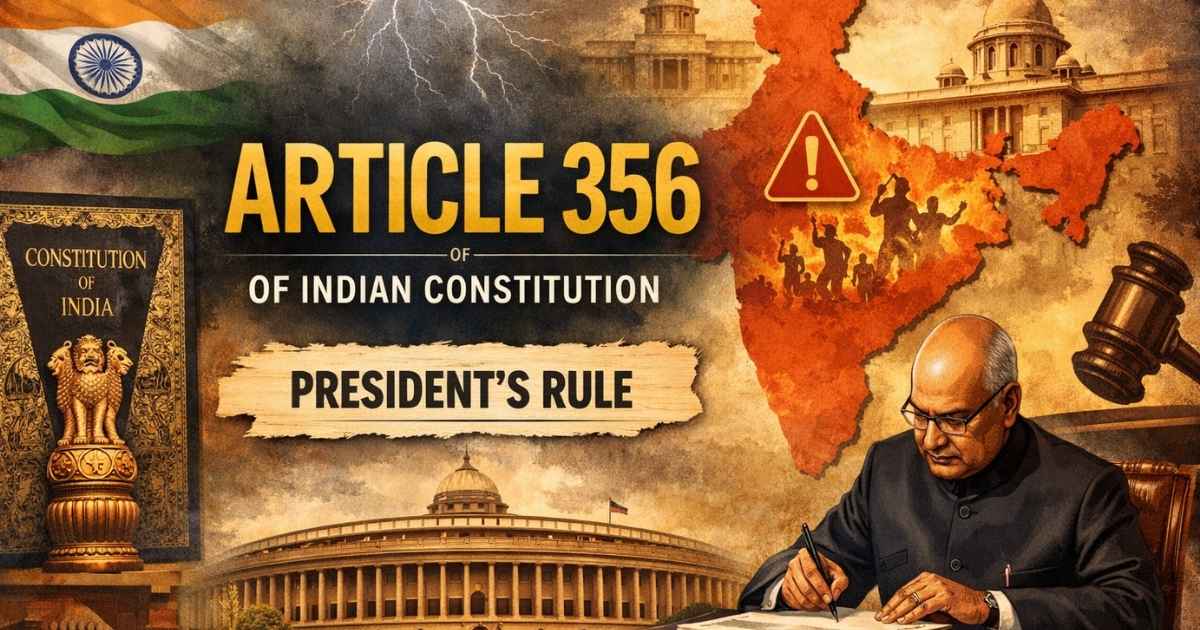
India follows a federal system where power is shared between the Union and the states. But sometimes a state government may fail to function according to the Constitution. In such situations, the Article 356 of Indian Constitution provides a constitutional mechanism to restore order. This provision allows the central government to intervene when there is a failure of constitutional machinery in a state.
In simple terms, this provision allows President’s Rule in India. When a constitutional governance breakdown occurs or the state government cannot function properly, the Union government can step in temporarily. The goal is not to punish the state but to maintain stability and protect the constitutional safeguards for state governance. It also plays an important role in maintaining centre-state relations in India when a serious constitutional breakdown in Indian states occurs.
Related Post: Section 281 of Bharatiya Nyaya Sanhita (BNS) 2023
Conditions and Procedure for Imposing President’s Rule
President’s Rule does not happen automatically. Usually, the process begins with a Governor’s report to the President stating that the state government cannot run according to constitutional rules. This step reflects the role of Governor in constitutional crisis. Based on this report or other information, the President may issue a proclamation by the President declaring President’s Rule under Article 356 of the Indian Constitution.
Once the proclamation is issued, the central government intervention in states begins. The suspension of state government powers may occur, and the state legislature may be suspended or dissolved. During this period, the legislative powers of Parliament over states become active because Parliament exercises authority over the state’s legislative matters. However, this decision must receive parliamentary approval of the proclamation within two months to continue.
Duration, Approval, and Revocation of President’s Rule in States
The duration of President’s Rule in India is carefully regulated to prevent misuse. Initially, the proclamation remains valid for six months. After that period, it can continue only if both houses of Parliament approve its extension. This process is part of the parliamentary approval of President’s Rule, ensuring democratic oversight.
However, there is a limit. The maximum period of Article 356 rule generally cannot exceed three years. Extensions beyond one year require special conditions, such as a national emergency or Election Commission certification for extension stating that elections cannot be conducted. During this time, the state administration takeover by the Union continues, and the role of Parliament during President’s Rule becomes crucial. Once normal conditions return, the revocation of President’s Rule proclamation takes place and elected government is restored.
| Feature | Explanation |
| Initial Duration | 6 months |
| Extension Requirement | Approval by both Houses of Parliament |
| Maximum Period | 3 years (with special conditions) |
| End of Rule | Revocation and restoration of elected government |
FAQs
What is Article 356 of the Indian Constitution?
It is a constitutional provision that allows the Union government to impose President’s Rule in a state when the state government cannot function according to the Constitution.
When can President’s Rule be imposed in a state?
It can be imposed when there is a constitutional machinery failure or when governance in a state breaks down.
How long can President’s Rule continue?
It initially lasts six months but can be extended with parliamentary approval up to a maximum of three years under specific conditions.
Who recommends President’s Rule to the President?
Usually, the state Governor submits a report explaining the situation and recommending action.
Can courts review the use of Article 356?
Yes. Through judicial review of President’s Rule, courts can examine whether the provision was used properly.
Conclusion
The Article 356 of Indian Constitution acts as a safety mechanism during a constitutional emergency at the state level. It ensures that governance continues even when a state government fails to function properly. While it allows the Union to step in during a serious Indian federal system crisis, it also includes strict safeguards to prevent misuse.
In practice, this provision balances stability with democracy. Parliamentary approval, time limits, and judicial review of President’s Rule ensure accountability. When used responsibly, Article 356 helps maintain constitutional order while protecting the spirit of India’s federal structure.

Arjun Sethi is a legal researcher and columnist specializing in constitutional and comparative law. A graduate of NALSAR University, he has published in leading law journals and advised policy think tanks. His work bridges theory and practice, offering readers precise, well-researched insights grounded in academic rigor and ethical clarity.