IPS Promotion Chart With Years: A Complete Career Progression Guide in the Indian Police Service
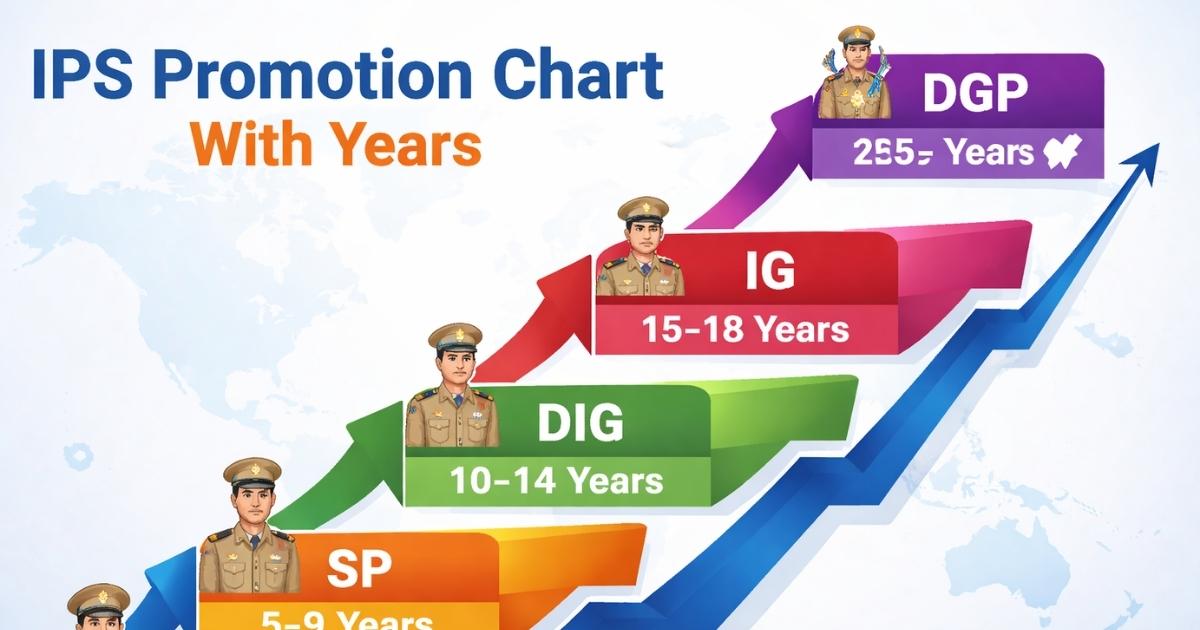
The Indian Police Service (IPS) stands among the most respected civil services in India. Officers in this service carry enormous responsibility. They protect citizens, maintain law and order, and manage complex security challenges. Many people know about the prestige of the service. However fewer people truly understand the long-term career path of an officer. That’s where the IPS promotion chart with years becomes helpful.
If you’re preparing for civil services or simply curious about the police leadership structure, understanding the IPS rank hierarchy can clarify many questions. For example, how long does it take to become a Superintendent of Police? What is the next rank after SP in IPS? How long does it take to become DGP? This guide explains the entire IPS career progression in clear, simple terms so you can understand how an officer moves from field training to the highest leadership positions.
Related Post: DSSSB TGT Female Age Relaxation: Complete Guide to Eligibility and Benefits
Indian Police Service (IPS)
The Indian Police Service is one of the three All India Services created under Article 312 of the Constitution of India. Along with the Indian Administrative Service and the Indian Forest Service, it forms the backbone of the country’s administrative framework. IPS officers are recruited through the Civil Services Examination conducted by the Union Public Service Commission (UPSC). Once selected, they undergo intensive training before starting their policing careers.
The structure of Indian Police Service ranks follows a well-defined administrative hierarchy. After training at the Sardar Vallabhbhai Patel National Police Academy, officers are assigned to a state cadre. From there their IPS officer career path progresses through various ranks depending on experience, seniority, and available vacancies. This carefully designed police rank structure India ensures that experienced officers gradually move into senior police leadership roles.
Why Understanding the IPS Promotion Chart With Years Matters
Understanding the IPS promotion chart with years helps people see the bigger picture of an officer’s professional journey. It explains how IPS career progression in India works and what kind of responsibilities officers handle at different stages of their service.
For aspirants preparing for UPSC, the IPS officer promotion timeline helps set realistic expectations. Promotions don’t happen overnight. Officers build their careers gradually by handling law and order situations, supervising investigations, and managing administrative duties. In simple terms, the IPS promotion ladder shows how field experience evolves into strategic leadership over time.
Entry Level: IPS Officer as Assistant Superintendent of Police (ASP)
The early stage of the IPS officer career timeline focuses heavily on learning and field exposure. Newly trained officers step into real-world policing where they handle ground-level operations and interact directly with communities.
During this stage officers observe the practical side of policing. They supervise police stations, coordinate patrol units, and assist senior officers during law and order operations. This period builds the foundation for the officer’s future role in the police administrative hierarchy India.
Rank: Assistant Superintendent of Police (ASP)
Assistant Superintendent of Police is typically the first operational rank in the IPS officer promotion stages. Officers usually hold this rank for the first few years of service while they learn about crime investigation, community policing, and district administration.
Typical responsibilities include:
- Supervising police stations
- Assisting district police leadership
- Handling crowd control and law-and-order situations
- Supporting criminal investigations
This stage shapes the officer’s understanding of real policing challenges.
Promotion to Superintendent of Police (SP)
After gaining field experience, officers usually move to the next stage of the IPS rank hierarchy. Promotion to Superintendent of Police is considered a major step because officers now lead entire districts.
The district superintendent of police role involves operational command and administrative leadership. The officer becomes responsible for public safety across a district and must coordinate with civil administration and intelligence agencies.
Rank: Superintendent of Police (SP)
The time required to become SP in IPS is generally around 4–6 years of service. At this level officers manage district policing and oversee hundreds of personnel.
Key duties include:
- Maintaining law and order across the district
- Supervising crime investigations
- Managing police personnel and resources
- Coordinating with district magistrates and other authorities
This stage marks the transition from learning policing to leading it.
Senior Superintendent of Police (SSP)
In larger cities or sensitive districts, officers may be designated as Senior Superintendent of Police. The position usually carries similar responsibilities to SP but with greater administrative scale and complexity.
SSPs often handle metropolitan policing or districts with significant crime challenges. They coordinate multiple police units and oversee major operations that involve intelligence, crime control, and community engagement.
Rank: Senior Superintendent of Police (SSP)
The SSP designation generally comes after 6–9 years of service depending on the cadre. The hierarchy of IPS officers places this rank within mid-level leadership where officers begin handling complex administrative responsibilities.
Responsibilities often include:
- Managing policing in large districts
- Supervising specialized investigation teams
- Coordinating large security operations
Deputy Inspector General of Police (DIG)
Promotion to DIG marks a shift from district policing to regional supervision. At this stage officers no longer lead a single district but supervise several districts within a range.
The DIG acts as a bridge between field officers and senior police leadership ranks. Their role focuses more on planning, monitoring, and administrative oversight.
Rank: Deputy Inspector General of Police (DIG)
The years required for DIG promotion IPS usually fall around 14–16 years of service. By this time officers have extensive experience in policing and leadership.
Key responsibilities include:
- Supervising multiple district police units
- Reviewing major investigations
- Monitoring law and order situations across regions
This rank reflects maturity within the IPS officer promotion system India.
Inspector General of Police (IG)
The Inspector General level belongs to senior leadership within the Indian police command structure. IG officers typically head police zones, special units, or state-level departments.
At this stage officers focus more on policy implementation rather than direct operational policing. They supervise DIGs and provide strategic direction to police forces across larger territories.
Rank: Inspector General of Police (IG)
Officers usually reach the IG rank after 18–20 years of service. The role involves coordinating large police formations and ensuring policy compliance across different administrative areas.
Responsibilities may include:
- Leading police zones or specialized wings
- Managing intelligence and crime monitoring units
- Coordinating with state government leadership
Additional Director General of Police (ADG)
The Additional Director General of Police rank sits near the top of the police administrative hierarchy India. ADG officers handle major departments such as intelligence, law and order, training, or crime branches.
Their decisions influence state-level policing policies and long-term security strategies. This role requires decades of experience and strong leadership capability.
Rank: Additional Director General of Police (ADG)
Most officers reach this stage after 25–30 years of service. The question of how IPS officers reach ADG rank often depends on seniority and the IPS cadre promotion system.
Typical responsibilities include:
- Leading major police departments
- Advising governments on internal security matters
- Managing coordination between state and central agencies
Director General of Police (DGP)
The Director General of Police is the highest rank in the state police force. Only a small number of officers reach this level due to limited posts and retirement age limits.
DGPs shape the strategic direction of policing within a state. Their leadership influences law enforcement policies, modernization programs, and public safety initiatives.
Rank: Director General of Police (DGP)
The answer to how long to become DGP in IPS generally ranges from 30–35 years of service. This position represents the peak of the IPS officer rank progression chart.
Responsibilities include:
- Overall command of the state police force
- Advising the government on internal security policy
- Overseeing large police organizations
Summary Table: IPS Promotion Chart With Years
The following table summarizes the IPS ranks from ASP to DGP and their typical service timeline.
| IPS Rank | Approximate Years of Service |
| Assistant Superintendent of Police (ASP) | 0–4 years |
| Superintendent of Police (SP) | 4–6 years |
| Senior Superintendent of Police (SSP) | 6–9 years |
| Deputy Inspector General (DIG) | 14–16 years |
| Inspector General (IG) | 18–20 years |
| Additional Director General (ADG) | 25–30 years |
| Director General of Police (DGP) | 30–35 years |
This IPS officer years of service chart provides a general guideline. Actual timelines may vary depending on cadre size and vacancies.
Factors Affecting IPS Promotions
Although the promotion structure seems straightforward, several factors influence how IPS officers get promoted.
Promotions follow IPS service promotion rules which combine seniority, performance evaluation, and administrative requirements. Understanding these factors helps explain why officers from the same batch sometimes progress at different speeds.
1. Seniority
IPS seniority based promotion plays a major role in career progression. Officers who join earlier or belong to earlier batches often receive promotions sooner.
2. Availability of Vacancies
Promotion also depends on the police officer promotion structure India. If senior posts are limited, officers may have to wait longer even if they are eligible.
3. Performance and Service Record
Confidential reports, professional integrity, and operational success influence promotion decisions.
4. Cadre Strength
Different states have different cadre sizes. Officers in smaller cadres may sometimes reach higher ranks faster.
5. Central Deputation
Officers serving with central agencies may gain broader exposure. However central postings don’t automatically guarantee faster promotions.
IPS Promotions Under Time Scale and Selection Grade
Apart from rank promotions, officers also receive pay-based progressions. These financial scales reflect experience even if the official rank remains unchanged.
Common pay progressions include:
- Junior Time Scale
- Senior Time Scale
- Selection Grade
- Super Time Scale
- Above Super Time Scale
These scales influence salary, authority, and eligibility for higher positions.
Difference Between Rank and Posting
Many people assume that rank and designation are always the same. In reality they can differ. An officer might hold the rank of DIG but serve in a posting normally associated with another designation.
This difference often occurs due to administrative requirements. The police administrative hierarchy India allows flexibility so governments can assign officers where they are most needed.
IPS Promotion Chart With Years: Common Misconceptions
Several myths exist about the IPS officer promotion system India. Understanding these misconceptions helps clarify the realities of policing careers.
Misconception 1: Promotions are automatic
Promotions require eligibility, vacancy availability, and vigilance clearance. They are not guaranteed merely by completing years of service.
Misconception 2: Every IPS officer becomes DGP
Only a small percentage of officers reach the top rank due to limited sanctioned posts.
Misconception 3: Promotions are uniform across India
Promotion timelines differ significantly depending on cadre strength and administrative policies.
Importance of Experience Over Rank
While rank progression matters, experience often matters more. Many officers earn respect through strong leadership, ethical decision-making, and effective policing.
A seasoned SP with exceptional field knowledge can sometimes influence public safety more directly than higher-ranking officers working in administrative roles. In policing, leadership quality often outweighs titles.
Myths vs Reality: IPS Promotion Chart With Years
| Myth | Reality |
| Every IPS officer becomes DGP | Only a few officers reach this rank |
| Promotions depend only on performance | Seniority and vacancies also matter |
| All cadres follow identical promotion timelines | Cadre strength affects promotions |
| Rank always equals posting | Officers may hold different designations |
Do’s and Don’ts Regarding IPS Promotions
| Do’s | Don’ts |
| Maintain a strong service record | Assume promotions are automatic |
| Gain diverse policing experience | Ignore administrative responsibilities |
| Stay updated on service rules | Rely on unofficial promotion information |
| Focus on public service | Chase rank without leadership skills |
Practical Illustrations: Understanding IPS Promotion Chart With Years
Real-life examples make the IPS promotion chart with years easier to understand.
Illustration 1: Early Career Progression
An officer who joins service in 2020 begins as ASP after training. By 2025 the officer becomes Superintendent of Police and leads a district police force.
Illustration 2: Mid-Career Transition
An officer joining in 2010 becomes DIG around 2025 after gaining experience in district leadership and crime management.
Illustration 3: Senior Leadership Level
An officer from the 1995 batch may reach the ADG or DGP level after decades of service and strong leadership performance.
Illustration 4: Cadre-Based Variation
Two officers from the same batch may experience different promotion speeds because of differences in cadre size and vacancies.
Conclusion
The career of an IPS officer follows a carefully structured progression designed to build leadership through experience. From the early days as an Assistant Superintendent of Police to the strategic command of a Director General of Police, every stage reflects growth in authority and responsibility.
Understanding the IPS promotion chart with years helps aspirants, students, and the general public grasp how the police leadership system works. While timelines offer guidance, dedication, integrity, and service to society ultimately define the true success of an IPS officer’s career.

Arjun Sethi is a legal researcher and columnist specializing in constitutional and comparative law. A graduate of NALSAR University, he has published in leading law journals and advised policy think tanks. His work bridges theory and practice, offering readers precise, well-researched insights grounded in academic rigor and ethical clarity.