DSSSB TGT Female Age Relaxation: Complete Guide to Eligibility and Benefits
The Delhi Subordinate Services Selection Board (DSSSB) plays a major role in recruiting teachers and staff for government schools in Delhi. Every year, thousands of candidates apply for teaching positions such as Trained Graduate Teacher (TGT). Among the many eligibility conditions, the age limit often becomes a deciding factor for applicants.
For women candidates, the government has introduced special relaxation policies. The DSSSB TGT Female Age Relaxation rule helps female aspirants participate more actively in teaching recruitment. This guide explains the age criteria, eligibility rules, legal rationale, documentation process, and important clarifications you should know before applying.
Related Post: Section 79 Bharatiya Nyaya Sanhita (BNS) – Word, Gesture or Act Intended to Insult the Modesty of a Woman
Basic Age Limit for DSSSB TGT Posts
Under normal recruitment rules, the upper age limit for TGT posts in DSSSB is generally below 32 years for candidates in the General category. This age is calculated based on the closing date of the online application mentioned in the recruitment notification.
For example, if the last date to apply is 8 March 2024, a candidate must be born on or after 9 March 1992 to remain eligible. These guidelines fall under the broader DSSSB teaching posts age limit and apply to most general category applicants in Delhi government teacher recruitment.
The DSSSB TGT age limit for female candidates may differ due to special relaxation provisions. However, candidates should always verify the DSSSB recruitment notification age criteria mentioned in the specific advertisement before applying.
DSSSB TGT Female Age Relaxation — Detailed Explanation
The DSSSB provides additional age relaxation benefits specifically for women applying for teaching posts. In several recruitment notifications, the board clearly states that the upper age limit of 32 years may be relaxed up to 40 years for female candidates.
This means that a female candidate may still apply even if she is older than 32 years, provided she does not exceed the maximum permissible limit mentioned in the advertisement. In simple terms, the maximum age for female candidates in DSSSB TGT recruitment can extend to 40 years for general category applicants.
For instance, if the application deadline is 8 March 2024, a female candidate born on or after 9 March 1984 may remain eligible. This policy forms the foundation of the DSSSB teacher recruitment age relaxation for women and provides wider opportunities for aspiring teachers.
Purpose and Legal Rationale of Female Age Relaxation
Age relaxation for women in government recruitment is not just a convenience. It reflects broader public policy goals aimed at encouraging gender equality and inclusive employment opportunities.
Many women experience career interruptions due to marriage, childcare, or family responsibilities. By extending the age limit, DSSSB ensures these candidates still have a fair chance to compete in Delhi government school teacher recruitment.
1. Promoting Gender Equality
Government recruitment policies often aim to improve women’s participation in public service. Teaching has traditionally been a profession where female educators play an important role. Through Delhi government teacher age relaxation rules, authorities promote equal access to teaching jobs.
This approach ensures women are not unfairly disadvantaged due to societal expectations or delayed career entry.
2. Recognizing Career Interruptions
Many female candidates pause their professional ambitions because of family responsibilities. Later, when they decide to resume their careers, strict age limits could otherwise block their entry.
By offering DSSSB female candidate age benefits, the recruitment system recognizes these interruptions and provides a second opportunity.
3. Encouraging Female Empowerment
Age relaxation also helps women pursue long-term professional goals. For many candidates preparing for teaching exams, the policy acts as a supportive measure.
It allows more qualified women to participate in Delhi subordinate services teacher recruitment and contribute to the education system.
4. Constitutional Backing
India’s Constitution permits the government to create special provisions for women to promote equality. Policies like government teacher job age relaxation align with these principles and support inclusive hiring practices.
Such rules strengthen fairness in public employment while maintaining merit-based selection.
Category-Wise Age Relaxation in DSSSB
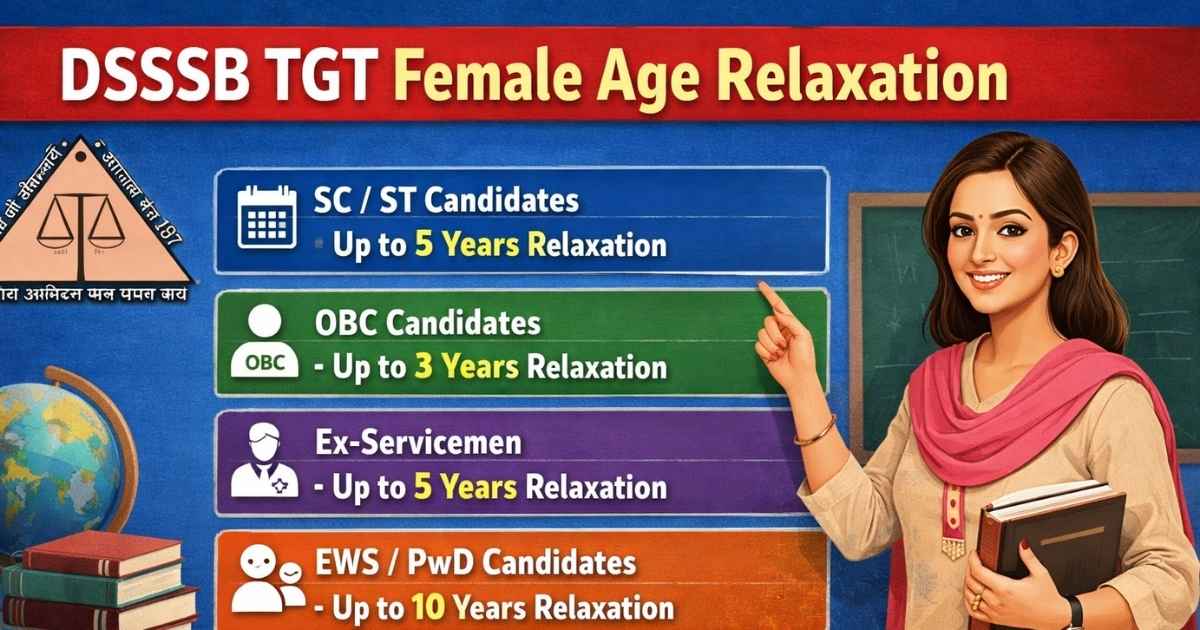
Apart from female-specific relaxation, DSSSB also offers age relaxation for reserved categories. The DSSSB recruitment age relaxation rules allow candidates from certain groups to receive additional age benefits.
| Category | Age Relaxation |
| OBC | 3 Years |
| SC/ST | 5 Years |
| PwBD | 10 Years |
| PwBD (SC/ST) | 15 Years |
| Female Candidates | Up to 40 Years |
These relaxations are part of the broader DSSSB age relaxation policy followed across multiple recruitment advertisements. However, the final eligibility depends on the exact wording of each notification.
Candidates should carefully check the DSSSB recruitment rules for female applicants before assuming combined benefits.
Illustration of Combined Relaxation
In some cases, candidates may qualify for multiple types of relaxation. This usually depends on category status, disability status, or departmental employment.
Understanding these scenarios helps clarify how much age relaxation for women in DSSSB TGT recruitment may apply.
Example 1:
Suppose a female candidate belongs to the OBC category.
Base age limit: 32 years
Female relaxation: up to 40 years
OBC relaxation: +3 years
Depending on the recruitment notice, the candidate may be eligible up to 43 years. However, candidates must always verify the conditions stated in the DSSSB advertisement age relaxation section.
Example 2:
Consider a female candidate from the SC category with PwBD status.
Base age limit: 32 years
Female relaxation: +8 years
SC relaxation: +5 years
PwBD relaxation: +10 years
If combined relaxations are allowed, the upper limit may extend further. These scenarios highlight the importance of reading the DSSSB TGT recruitment rules carefully.
Verification and Documentation
Claiming age relaxation requires accurate documentation during the recruitment process. Candidates must ensure their personal details match official records.
Typically, the following documents may be required:
- Matriculation certificate for date of birth proof
- Category certificate (SC/ST/OBC) if applicable
- PwBD certificate issued by a competent authority
- Government employee certificate for departmental candidates
All these details must match the information provided in the DSSSB online application eligibility form. Incorrect or missing documents may lead to rejection during verification.
Common Misunderstandings about DSSSB Female Age Relaxation
Many applicants misunderstand the rules related to female age benefits. Clarifying these points can help candidates avoid mistakes.
One common myth is that all female candidates automatically receive an additional ten years of relaxation. In reality, the rule often states that the upper limit is relaxable up to 40 years, not beyond it unless additional category benefits apply.
Another misunderstanding is that female relaxation applies to every DSSSB post. In fact, the DSSSB recruitment eligibility criteria may differ between TGT, PGT, and other positions.
Steps to Check and Claim Age Relaxation
If you want to confirm your eligibility, follow a simple step-by-step approach.
- Visit the official DSSSB recruitment website.
- Open the latest recruitment advertisement.
- Look for the “Age Limit” section in the notification.
- Check the DSSSB TGT age calculation cut off date mentioned.
- Calculate your age based on the deadline.
- Apply online through the DSSSB application portal.
These steps help ensure you meet the DSSSB teacher recruitment eligibility Delhi guidelines before submitting your application.
Do’s and Don’ts for Female Candidates
Do’s
- Carefully read the recruitment advertisement
- Calculate your age using the official cut-off date
- Keep all supporting documents ready
- Verify category certificates before submission
Don’ts
- Do not assume relaxation without checking the notification
- Do not rely on outdated recruitment rules
- Do not submit incorrect documents
- Do not ignore official announcements or corrigenda
Key Takeaway
Age relaxation policies play a significant role in expanding employment opportunities for women in public service. By allowing additional years beyond the standard age limit, DSSSB encourages more female candidates to apply for teaching posts.
These rules help bridge career gaps and ensure qualified educators can contribute to the education system. Understanding the DSSSB TGT Female Age Relaxation provisions can greatly improve your chances of planning your application correctly.
DSSSB TGT Female Age Relaxation — Updated Clarification (As per Latest Notifications)
Recent DSSSB advertisements have shown some variation in the way age relaxation rules are presented. Earlier notifications clearly mentioned that female candidates could apply up to 40 years of age for TGT posts.
However, some newer recruitment notices focus primarily on category-based relaxation such as SC, ST, OBC, and PwBD. Therefore, candidates should carefully check the DSSSB TGT age relaxation notification details before submitting their applications.
The safest approach is to rely only on the language used in the specific recruitment advertisement.
Conclusion
The DSSSB TGT Female Age Relaxation policy reflects the government’s commitment to creating equal opportunities in public sector recruitment. By extending the upper age limit for women, the system acknowledges real-world challenges such as career breaks and family responsibilities.
If you are planning to apply for a TGT position in Delhi government schools, carefully review the recruitment notification and calculate your eligibility accurately. With the right preparation and awareness of the rules, you can take full advantage of these opportunities and pursue a rewarding teaching career.

Arjun Sethi is a legal researcher and columnist specializing in constitutional and comparative law. A graduate of NALSAR University, he has published in leading law journals and advised policy think tanks. His work bridges theory and practice, offering readers precise, well-researched insights grounded in academic rigor and ethical clarity.