Who Are Agnates and Cognates? Understanding Family Relations in Hindu Succession Law
Inheritance disputes can turn families into courtrooms. And when no will exists, the law steps in sometimes pointing to relatives you barely knew existed. That’s exactly where agnates and cognates enter the picture. These two terms sit at the heart of Hindu succession law and quietly determine who walks away with property when closer family members aren’t around. If you’ve ever wondered what happens to a person’s estate when their immediate family is gone, this guide answers that clearly, practically, and without drowning you in legal jargon.
Understanding who qualifies as an agnate or cognate isn’t just academic. It directly affects real inheritance outcomes for millions of Hindu families across India. The Hindu Succession Act, 1956 lays out a structured hierarchy and agnates and cognates occupy crucial positions within it. Let’s break it all down.
Related Post: Understanding Section 25 of the Arms Act, 1959: Legal Provisions, Punishments & Case Law Insights
Meaning of Agnates and Cognates
Hindu inheritance law doesn’t treat all relatives equally. It draws a sharp line between those connected through the male line only and those connected through a female link at any point. That distinction simple on paper carries enormous legal weight when property is on the line.
The Hindu Succession Act, 1956 codifies these definitions under Section 3(1)(a) and Section 3(1)(c). Together, these two provisions map out a wide web of family relationships that courts use to determine rightful heirs in intestate succession across India.
1. Who Are Agnates?
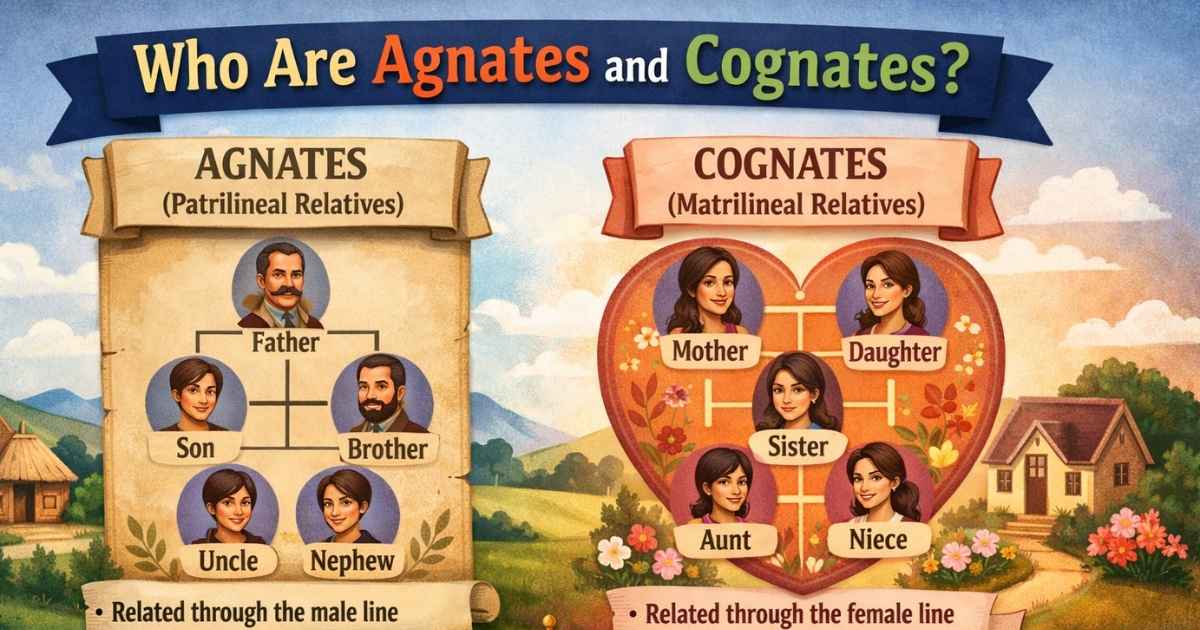
Section 3(1)(a) defines an agnate as someone related to another by blood or adoption wholly through males. Every link in the chain every single step must pass through a male. No female connects them anywhere along the way. Think of it as a straight line drawn only through fathers, sons, brothers, and grandfathers. That’s the agnatic relationship in its purest form.
2. Who Are Cognates?
A cognate, under Section 3(1)(c), is someone related by blood or adoption but not wholly through males. At least one female link exists somewhere in that chain. The relationship might pass through a mother, sister, or daughter at some point. Cognates form a broader category and because of that female link, they rank lower in the succession hierarchy under Hindu law.
Examples for Better Understanding
Legal definitions only go so far. Real clarity comes from seeing how these relationships actually work. Let’s walk through some concrete examples so you can spot an agnate or cognate in your own family tree.
A few side-by-side examples make the difference crystal clear. Once you see the pattern, it’s hard to forget the presence or absence of a female link tells you everything.
Agnates Examples
Your father’s brother is your agnate. You trace that relationship as: you → your father → your father’s brother. Every link is male. Similarly, your brother’s son is an agnate you → your brother → his son. Your own grandson (son’s son) is also an agnate. No female appears in any of these chains. That’s the defining mark of agnatic relationship meaning in practice.
Cognates Examples
Your mother’s brother is your cognate. The chain runs: you → your mother → her brother. A female link your mother sits right in the middle. Your sister’s son is also a cognate because you reach him through your sister. Even your daughter’s son qualifies as a cognate because the relationship passes through your daughter. Wherever a woman appears in that chain, you’re looking at a cognate, not an agnate.
The Hierarchical Order of Succession
So where exactly do agnates and cognates fit into the broader picture? Section 8 of the Hindu Succession Act lays out a four-step hierarchy that courts follow when a male Hindu dies without a will. It’s a clear, top-down structure and distant relatives only come into play when everyone above them is gone.
Here’s how property succession rules in India operate under intestate succession:
| Priority | Heirs |
| 1st | Class I Heirs (mother, widow, sons, daughters) |
| 2nd | Class II Heirs (father, siblings, nephews, nieces) |
| 3rd | Agnates |
| 4th | Cognates |
Agnates inherit before cognates always. And if no cognates exist either? The property escheats to the Government under Section 29 of the Act. So the stakes are real. Identifying the right heir, even a distant one, can keep property out of government hands.
Rules of Preference Among Agnates and Cognates
Not all agnates are equal. Neither are all cognates. When multiple relatives from the same category come forward as potential heirs, the law applies specific rules to decide who gets priority. Sections 12 and 13 of the Hindu Succession Act handle this neatly.
These rules keep the process fair and predictable. Courts don’t pick favorites they follow degree calculations to determine who stands closest to the deceased.
Rule 1: Degree of Relationship
Whoever is closer in kinship degree inherits first. A grandfather (two degrees away) takes priority over a great-uncle (four degrees away). Kinship degree calculation counts each generational step as one degree both upward and downward through the family tree.
Rule 2: Equal Degree
When two or more agnates or cognates share the same degree of relationship, they inherit simultaneously and equally. Two brothers, for instance, split the inheritance right down the middle. No one gets an edge simply because of gender or age within the same degree.
Rule 3: No Class Preference
The law draws no distinction between lineal relatives (direct descendants or ancestors) and collateral relatives (uncles, cousins) when both share the same degree. Proximity alone decides nothing else. A direct descendant and a collateral relative at equal degrees stand on perfectly level ground.
Tracing the Line of Descent
Tracing descent sounds complicated but follows a logical pattern. You simply count the steps between two people through their common ancestor and note whether any step passes through a female.
Here’s a quick visual to clarify:
Agnatic Chain: You → Father → Grandfather → Great-grandfather
(All male links purely agnatic)
Cognatic Chain: You → Mother → Grandfather → Uncle
(Female link at step one cognatic)
Lineal kinship runs straight up or down son, father, grandfather. Collateral kinship branches sideways from a shared ancestor uncles, cousins, nephews. Both types can be either agnatic or cognatic depending on the gender of the links in between. The genealogical succession chart a court uses will map every link carefully before deciding who qualifies.
Why Agnates Precede Cognates
Here’s the honest answer. The preference for agnates over cognates comes straight from the patrilineal roots of Hindu family law. Historically, property flowed through the male line father to son, son to grandson. Women who married left their birth family and joined their husband’s. The law reflected that social reality.
Does that system feel dated today? Possibly. But it’s still embedded in the 1956 Act’s framework for distant relatives. The Hindu Succession (Amendment) Act, 2005 made daughters equal coparceners a massive reform. Yet the agnate-before-cognate rule stayed untouched for cases where Class I and II heirs don’t exist. Male lineage inheritance still holds priority at that level.
Adoption and Its Impact on Agnatic and Cognatic Relations
Adoption doesn’t create second-class heirs under Hindu law. An adopted child steps fully into the shoes of a natural-born child same rights, same status, same place in the family tree. This matters enormously for succession purposes.
So yes an adopted son becomes an agnate of his adoptive father’s relatives, provided the relationship traces purely through males. An adopted daughter, on the other hand, might qualify as a cognate of certain relatives because she introduces a female link into the chain. Adoption and inheritance rights in India work together seamlessly under this framework. The court treats the adoptive family as the legal family full stop.
Agnates and Cognates in Case Law
Courts haven’t just applied these rules mechanically they’ve shaped and sharpened them through landmark judgments. Three cases stand out as particularly instructive for understanding how who are agnates and cognates understanding family relations in Hindu succession law plays out in real courtrooms.
These decisions give the abstract statutory language real meaning. They’re worth knowing, especially if you’re navigating an inheritance dispute.
1. Gurupad Khandappa Magdum v. Hirabai Khandappa Magdum (1978 AIR 1239)
This case tackled partition and the rights of female heirs within the Hindu succession framework. While its primary focus wasn’t agnates and cognates directly, it reinforced how courts interpret lineal descent and the rights flowing through succession. It established that the succession structure must be read purposively not mechanically to deliver just outcomes.
2. Shakuntala Devi v. Kamla & Ors (2005 SCC 313)
This is the cleaner precedent for our purposes. The Supreme Court confirmed that property devolves upon agnates first and cognates only after and this hierarchy isn’t optional. Courts can’t skip a step or rearrange the order. The legal heir hierarchy in India is fixed by statute and must be followed strictly when no Class I or II heirs exist.
3. Satyendra Nath Dutta v. Shyam Sunder Dutta (Calcutta High Court, 1996)
The Calcutta High Court clarified how to calculate degrees of relationship when determining priority among agnates. It held that the chain of relationship must be traced without interruption every link counts, every degree matters. A gap or assumed connection doesn’t hold up. The genealogical chain must be provable and unbroken.
Agnates and Cognates in Modern Context
Modern India looks different from 1956. Nuclear families are the norm. People migrate, lose touch with extended family and sometimes die without a single close relative nearby. In those situations, distant relatives inheritance rules suddenly become very relevant and agnates and cognates step into the spotlight.
Think about an unmarried person who dies without a will and without children. Or a widow who outlived everyone close to her. In these cases, tracing agnatic or cognatic descent becomes the only way to identify a legal heir. Rural families, joint family disputes, and ancestral property distribution cases frequently involve these provisions. They’re not relics they’re live legal tools.
Gender Equality and Legal Reforms
The 2005 amendment was a landmark moment. It gave daughters equal rights as coparceners in Hindu Undivided Families reversing centuries of exclusion. Sons no longer hold an automatic advantage over daughters in coparcenary property. That’s a genuine step toward equity.
But here’s the nuance. The agnate-cognate classification under Sections 8–13 remains intact. When succession reaches that level beyond Class I and II heirs the traditional male-line preference still applies. Legal reforms have moved the needle significantly but haven’t erased this framework entirely. The broader trend is clearly toward gender neutrality and perhaps future amendments will address this too.
Practical Application in Succession Planning
Understanding this framework saves you headaches and potentially saves your family from costly legal battles. Whether you’re drafting a will or helping resolve a property dispute, knowing who qualifies as an agnate or cognate gives you a real advantage.
Here’s where this knowledge becomes practically useful:
- Drafting a Will Specify beneficiaries clearly. Don’t leave room for distant relatives to contest.
- Succession Certificates Courts require identification of legal heirs. Knowing your position as an agnate or cognate speeds this up.
- Property Mutation Revenue authorities need a clear legal heir. Genealogical documentation matters.
- Partition Suits When a family disputes ancestral property distribution, tracing agnatic or cognatic lines determines who has standing.
- Adoption Planning Understanding how adoption affects heir status helps families plan strategically.
Comparison Table: Agnates vs. Cognates
| Basis | Agnates | Cognates |
| Definition | Related wholly through males | Related through at least one female link |
| Line of Descent | Male lineage only | Mixed includes female links |
| Example | Father’s brother, brother’s son | Mother’s brother, sister’s son |
| Priority | Higher inherit before cognates | Lower inherit after agnates |
| Legal Basis | Section 3(1)(a), HSA 1956 | Section 3(1)(c), HSA 1956 |
| Kinship Type | Patrilineal | Matrilineal or mixed |
| Scope | Narrower group | Broader group |
Conclusion
Agnates and cognates aren’t just dusty legal terms. They’re the safety net that Hindu succession law throws out when closer family isn’t around. Understanding who qualifies and in what order they inherit can mean the difference between a family keeping its property and watching it disappear into government coffers. The Hindu Succession Act, 1956 built this framework deliberately and courts continue applying it daily in real inheritance disputes across India.
If you’re dealing with an intestate estate, planning a will, or simply want to understand your own legal standing in your family’s property picture, knowing these concepts gives you a head start. The law rewards those who understand it. So whether you’re a distant relative quietly wondering about your rights or a legal professional advising a client, this framework is one you can’t afford to overlook.

Arjun Sethi is a legal researcher and columnist specializing in constitutional and comparative law. A graduate of NALSAR University, he has published in leading law journals and advised policy think tanks. His work bridges theory and practice, offering readers precise, well-researched insights grounded in academic rigor and ethical clarity.